01
Home / Projects / SIG Areal App
Case Study · Progressive Web App for an Industrial Site

SIG Areal App.

A digital guide for the SIG Areal in Neuhausen am Rheinfall, Switzerland. Find companies, find your way, plan tours, check live train departures, book rooms. Twelve languages, no download, one tap.

View the app →
QR code that opens the SIG Areal App at sigareal.app

sigareal.app

Client SIG Gemeinnützige Stiftung
Location Neuhausen am Rheinfall, SH
Sector Site & estate development
Type Progressive Web App
Languages 12 · incl. RTL
Year 2026 · live
02
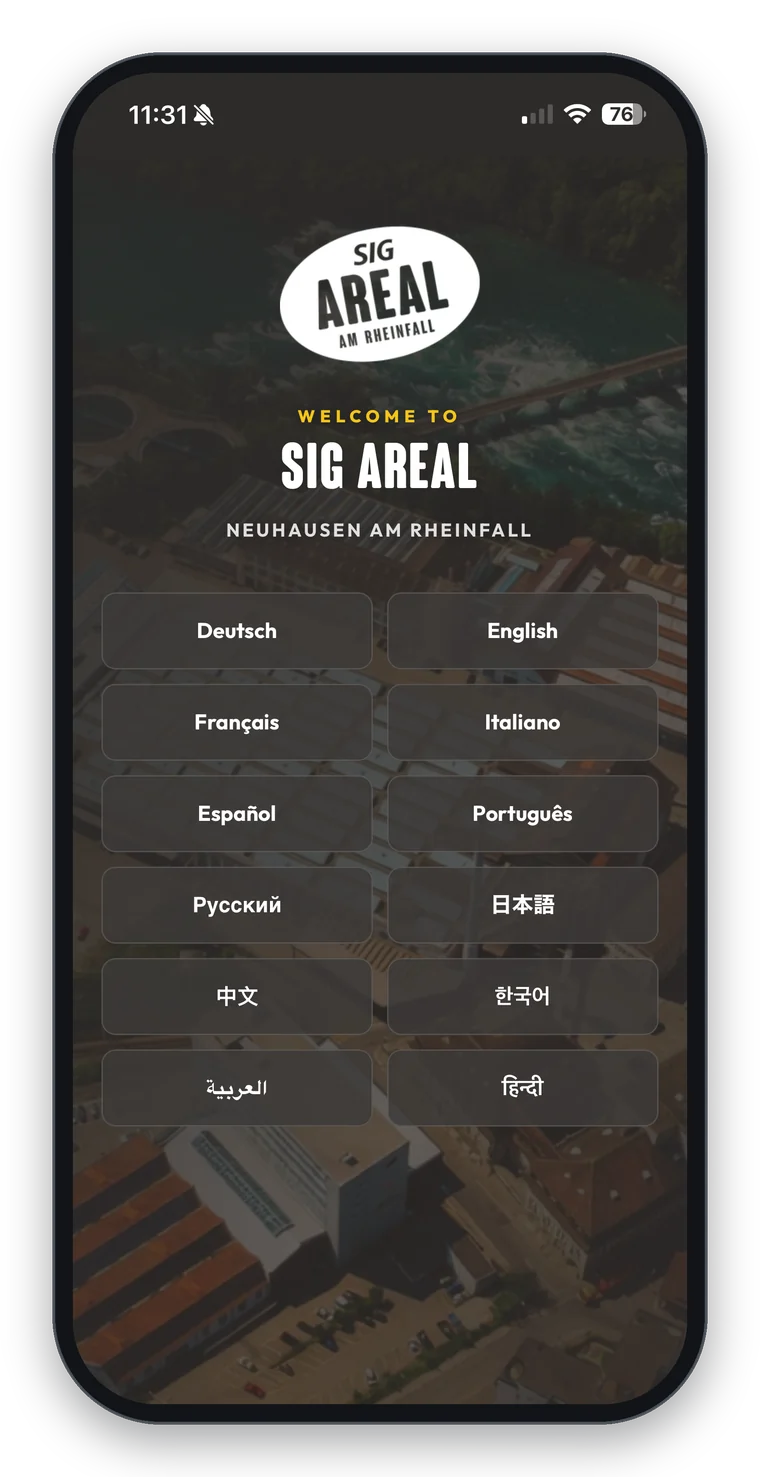
Language selection screen of the SIG Areal App with twelve languages from German to Hindi
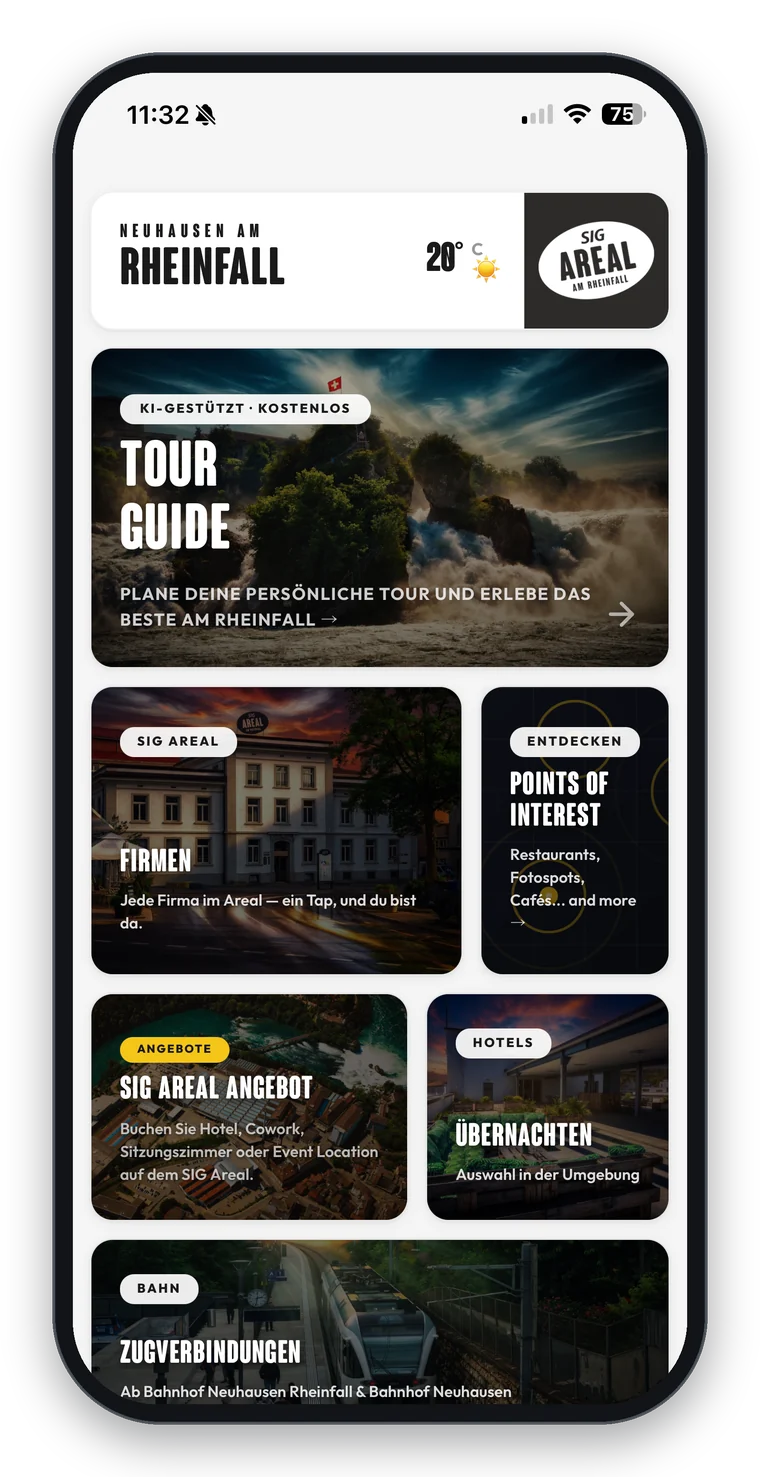
Home screen of the SIG Areal App with weather, tour guide and tiles for companies, points of interest and offers
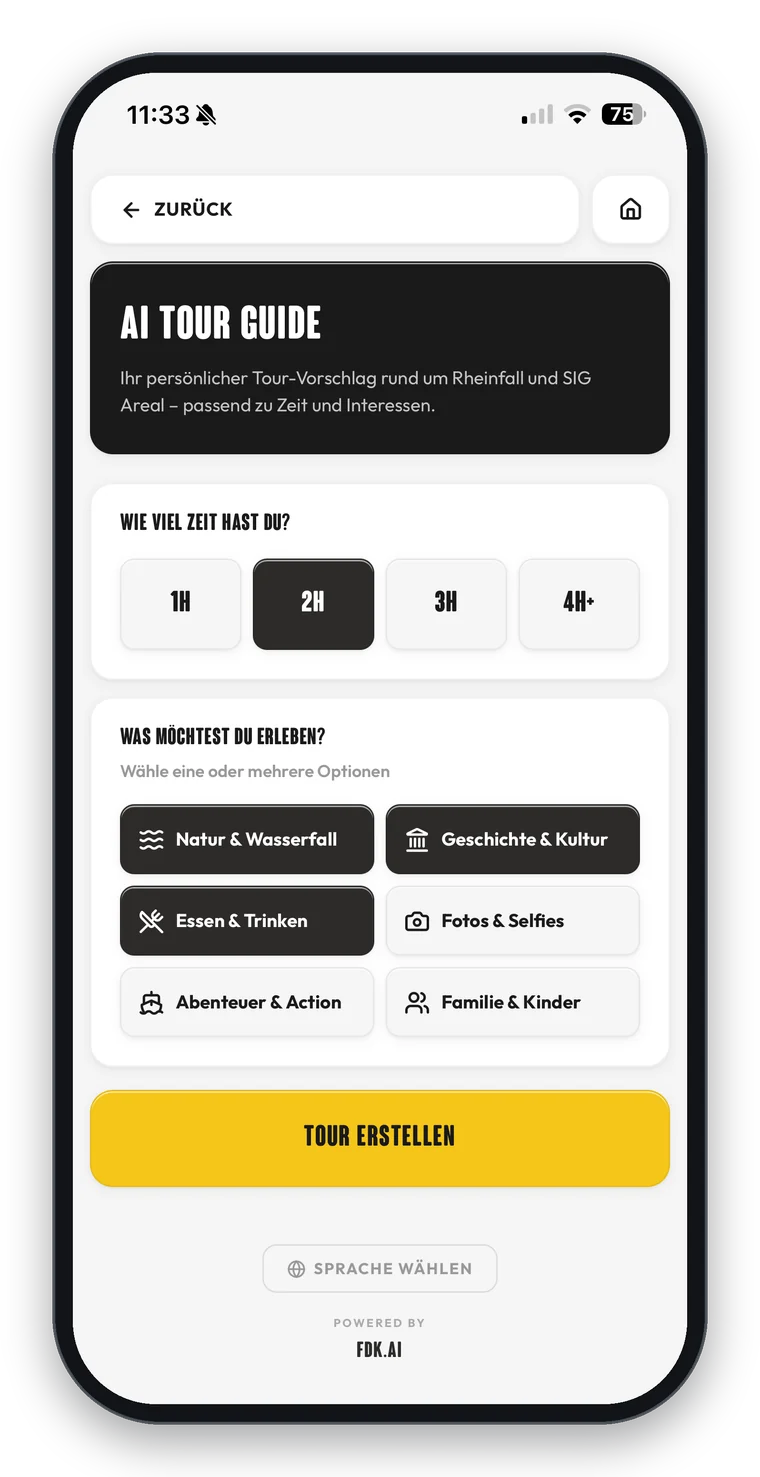
The AI tour guide of the SIG Areal App with selection of available time and interests

Mobile first, built for the moment someone is standing in the middle of the site looking for something.

03
The trigger

Five years, the same question.

This case study does not begin with a briefing. It begins with an observation. I have been a tenant on the SIG Areal for almost five years. Anyone who walks in and out of here every day gets asked the same questions again and again, by visitors who are here for the first time: Where are the toilets? Where do I find the restaurant? Which way to the Rhine Falls? How do I get back to the station?

And it is not just the visitors. Postal workers and couriers kept running into the same problem. A great many companies on the site share one and the same address, Industrieplatz 1. The site is large and the companies are spread across it, while Industrieplatz 1 is the main building right where you arrive. A correct address does not necessarily lead to the right door here.

The app grew out of that one recurring situation. Not out of a campaign idea, but out of a problem that stood visibly on the square every single day. The longer I kept looking, the more came up, and that is exactly why the app is as comprehensive as it is today.

04
The core decision

Nobody downloads an app for two hours.

Neuhausen am Rheinfall lives on day visitors. Most of them stay between one and four hours. Nobody who is here that briefly installs anything from an app store. The journey through search, install, permissions and first launch is longer than the visit itself. A native app would have been built and left unused.

That is why the SIG Areal App is a progressive web app. One tap on the QR code or the link and it is there. No store, no installation, no account. Anyone who wants to keep it adds it to their home screen in two taps and from then on has it like an installed app, full screen, no browser bar.

The same thinking sits behind the twelve languages. I did not guess which languages were needed. I watched for years who actually arrives here. German, English, French, Italian, Spanish, Portuguese, Russian, Japanese, Chinese, Korean, Arabic and Hindi. Arabic including right-to-left rendering.

That is why the very first thing you see is the language screen. Twelve tiles, one tap, done. You make that choice exactly once: the app remembers your language for a full year and opens straight in it the next time. You can switch at any point in the footer.

Simplicity is not a buzzword here. It is the hardest requirement in the entire project. Anything that stands between a person in the middle of the site and their answer is a defect.

05

Scope

What I built.

Twelve building blocks that together form a complete guide to an industrial site, multilingual from day one and usable without installing anything.

Company directory with navigation

Every company on the site with category, description, opening hours, phone number and a button that navigates you to the right door. This solves the Industrieplatz 1 problem.

AI tour guide

Pick your available time and your interests, and the app assembles a personal route, in a sensible order and with realistic walking times.

Points of interest

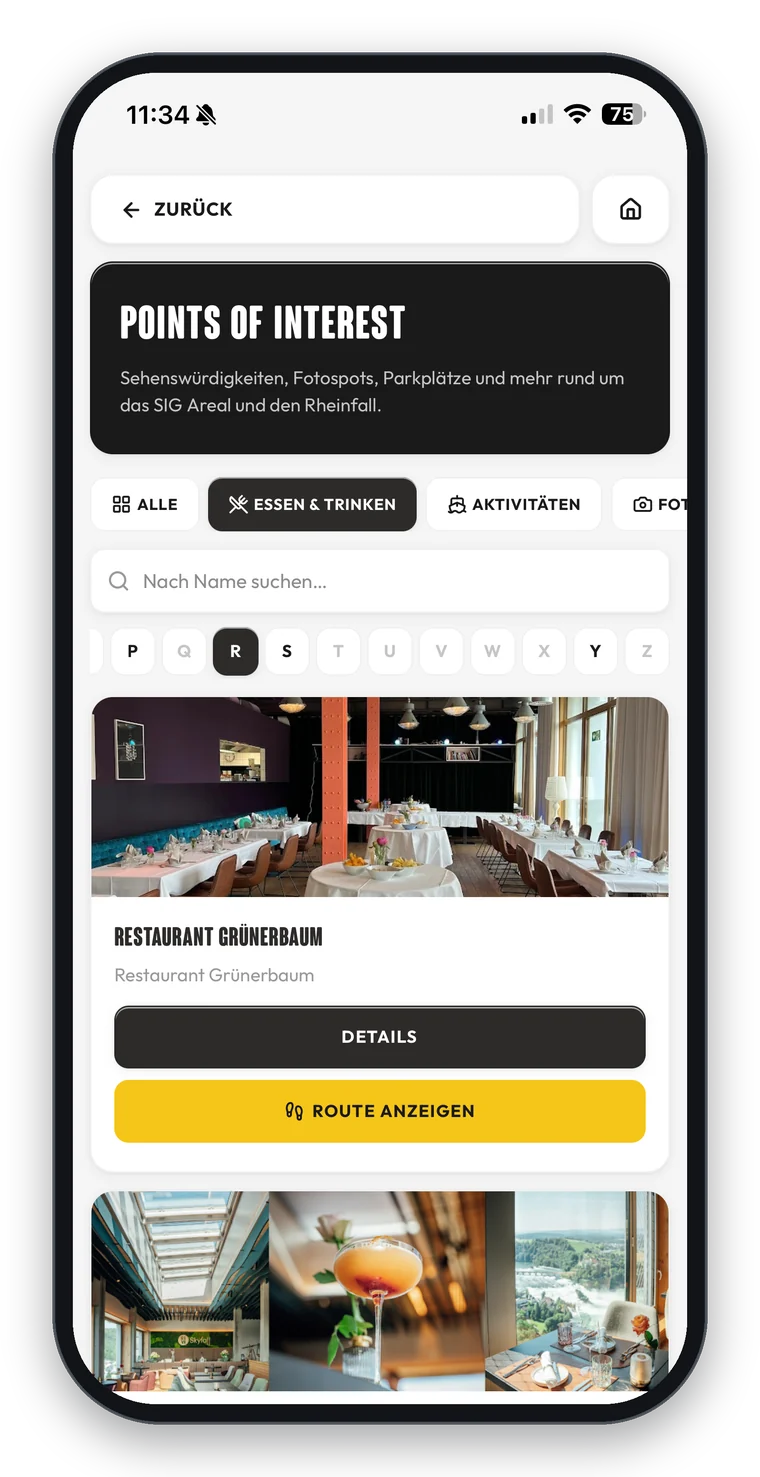
Sights, activities, photo spots, parking and information points on the site and nearby, filterable and searchable.

Food and drink

Restaurants, bars, cafés, takeaways and supermarkets with photos, opening hours, contact details and, where available, the menu.

Places to stay

Hotels in the surrounding area with detail pages and navigation, not just the offers on the site itself.

Direct booking

Mini hotel, coworking, three meeting rooms and the event location, all bookable inside the app through an embedded booking system.

Events

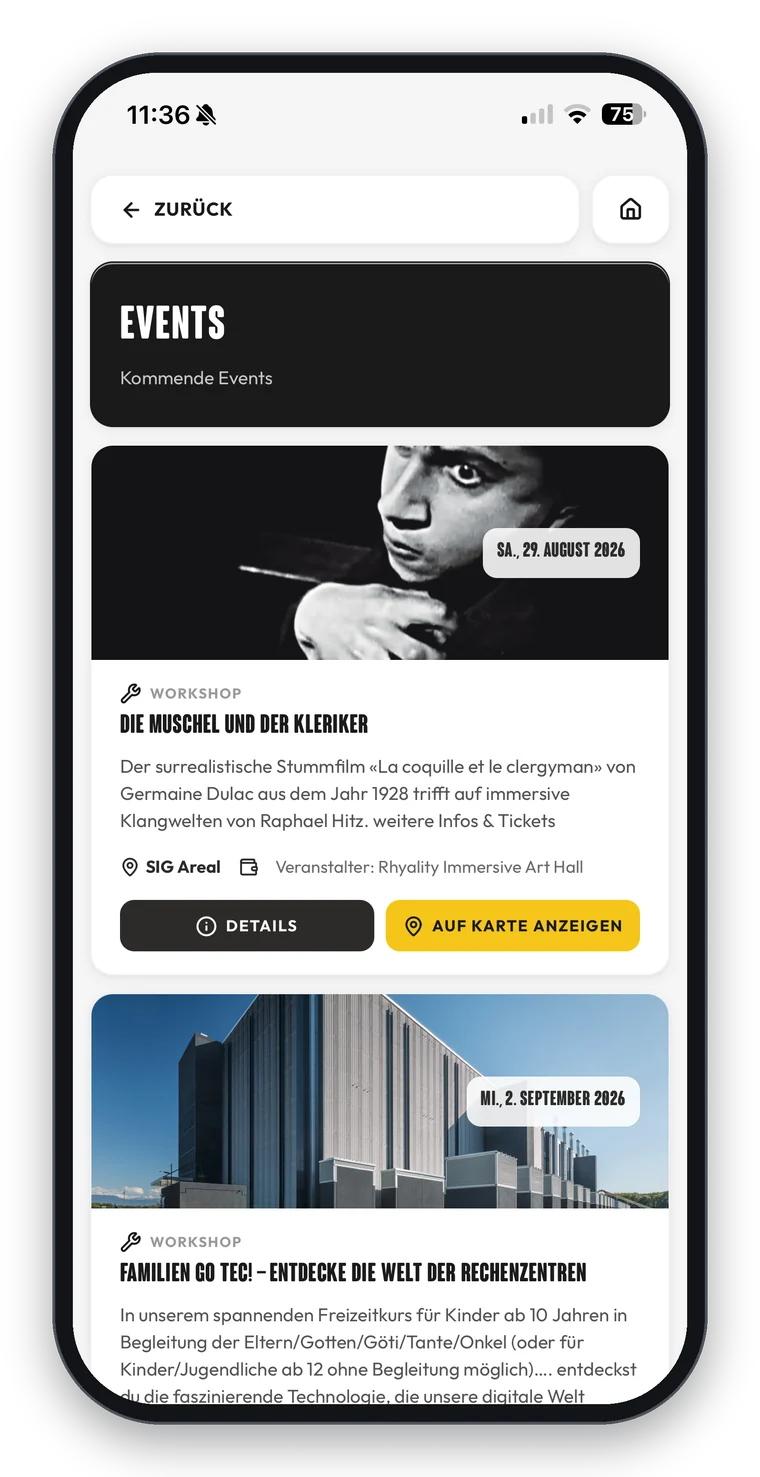
The site's event calendar with date, venue, price and organiser. Official events are imported automatically from the site's website and translated.

Live train departures

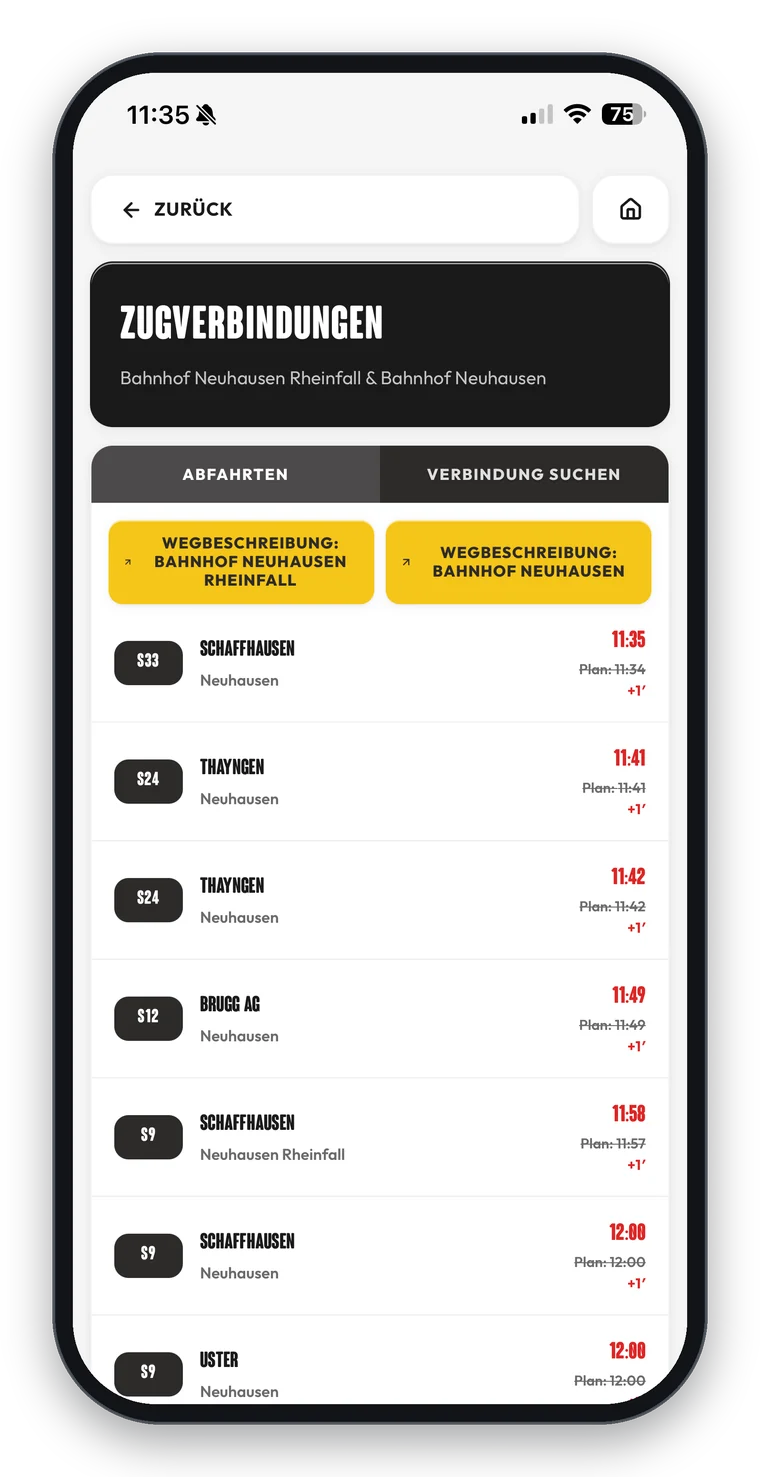
Real departure times from both stations, with delays, platforms, changes and a connection search. Data from the Swiss timetable system, refreshed every minute.

Toilets, info, SOS

The three things you only look for when you need them right now. Public toilets with directions, information points and an SOS page with one-tap dialling of police and ambulance.

Twelve languages

All content stored multilingually, language chosen on first launch and remembered for a year, Arabic with right-to-left rendering. AI-assisted translations directly in the admin area.

Admin area (CMS)

Companies, places, events, menus, hiking routes, images and users are maintained centrally, with roles, an audit log and a preview before saving.

Analytics without tracking

Page views, languages and dwell time are recorded anonymously. No IP addresses, no tracking cookies, no profiles. Do Not Track is respected.

06

Decisions

Why not just a map?

The most frequent question in this project, and the best one. Five answers, which together explain why the app is built the way it is.

You cannot search for what you do not know exists.

A map answers questions. But it only answers questions someone already knows how to ask. If you do not know there is a mini hotel, a coworking space, a viewpoint or a particular restaurant on the site, you will never search for it. The app reverses the direction: it first shows you what exists, and only then navigates.

An address is not a route.

When dozens of companies share one street address, the address helps nobody. In the app, every entry has its own coordinates. One tap leads to the building, not to the site entrance. That was the original trigger for the whole project.

Everything in one place, not across six channels.

Before, the information was scattered: website, notice boards, timetable, booking pages, event calendar. The app brings it together in one place. Whoever arrives needs one address in their head, not six.

Usefulness comes before the message.

The app does not advertise. It is useful, and precisely through that it becomes the site's strongest channel. Every company, every offer, every event is part of a tool that people open voluntarily, because they need something right now.

Employees are the second audience.

Day visitors come once. People who work here come every day. For them, the company directory, the lunch options, the timetable and the meeting-room calendar are the reason to keep the app. That is the difference between a campaign and a tool.

07
Why it convinced

Marketing that is useful.

What convinced in the end was not the feature list but the category. The SIG Areal App is brand utility: brand work that does not interrupt, it helps. Nobody skips it, nobody blocks it, nobody has to endure it. It gets opened because, in that moment, it is the most useful thing on the screen.

That is my specialty and the conviction behind the project: the product is the marketing. A tool that people use voluntarily creates more loyalty than any ad they click away. For a site that welcomes visitors anyway, this is the most obvious and at the same time the most rarely chosen form of marketing.

That it fit here also comes down to the place itself. The SIG Areal is run with a modern, forward-looking mindset. A digital guide is not a foreign idea there. It is the logical continuation of what is already happening on the site.

Points of interest in the SIG Areal App with filters for restaurants, activities and photo spots
Live train departures in the SIG Areal App with departure times, platform and delay
Events on the SIG Areal in the app, with date, venue and details
08
Under the hood

What visitors never see.

The app runs on Next.js with a Supabase database that rules out public write access entirely. Content is read openly; writes happen only server-side through protected access. Images live in the same system, and the admin area is secured through roles, session checks and an email allowlist.

The live data comes from several sources: departures and connections from the Swiss timetable system, weather through a cached weather service, official events directly from the site's website. Translations are AI-assisted, with a fallback to the original texts if a service is ever unreachable. If a source fails, the app shows a neutral placeholder instead of an error message.

On top of that comes the infrastructure you only notice when it is missing: a manifest and service worker so the app can be installed, structured data and Open Graph tags for search engines and shared links, anonymous analytics without cookies, and an audit log of every change in the admin area.

09
Outcome

Live. And transferable.

The SIG Areal App has been running at sigareal.app since 2026 and is licensed to the SIG Gemeinnützige Stiftung, the charitable foundation that owns the site. Today it covers the site itself, the food and hotel scene around it, the events, the bookable offers and public transport, and it is maintained by the site's own team through the admin area.

Underneath the app sits day.guide, the fdk.ai platform for AI-powered destination guides. The SIG Areal is its first named Swiss deployment. What was developed here, the tour guide, the company directory with navigation, the twelve languages, the live timetable, flows back into the platform and is available to further locations, in Switzerland and beyond.

For site operators, municipalities and tourism organisations this means: the path from idea to running app is considerably shorter than it was here, because the platform exists. What remains is the work that is genuinely local, understanding which questions people actually ask on the ground.

fdk

Your location

Your site. Your app.

Whether you run a site, a municipality or a tourism region: tell me which questions your visitors keep asking. I will tell you whether and how an app can answer them, what it costs and how quickly it can go live.